
Property and real estate developers in Canada face multiple challenges when completing a successful project. Getting a real estate project approved, built, and sold involves juggling a huge amount of data across multiple projects. Without the right tools it can be overwhelming to manage buyer leads, follow ups, and sales pipelines alongside project completion timelines and compliance requirements. Real estate CRM software for property builders meets the unique needs of builders and real estate developers and helps you build and manage relationships throughout the sales process.
This guide will walk you through everything you need to know to choose the right CRM for your real estate business.
What is a Real Estate CRM for Property Builders?
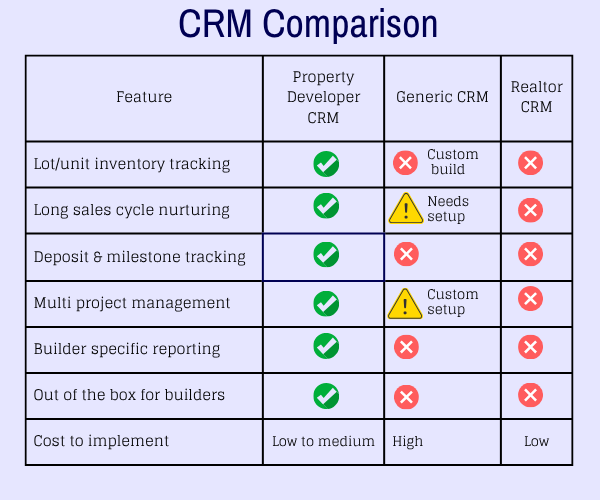
A CRM is customer relationship management software. Not all CRM software has the same functionality. The unique requirements of the real estate industry mean that your real estate builder software should support your unique needs. Generic CRM software may not have the functionality to track lot and inventory, or to support and nurture a long sales cycle. Your CRM needs features that help you manage multi-phase projects, handle deposits, and track individual décor and extras requirements for your customers.
If it costs more to configure the software to reflect how builder sales actually work, or to develop critical reporting like absorption rates and sales per project, it may not be the ideal property developer CRM.
Signs You’ve Outgrown Your Current System
What are some signs your business has outgrown your current system and it’s time to evaluate a new CRM that’s built for homebuilders in Canada?
If you’re using spreadsheets or sticky notes to manage your leads or missing follow ups because you don’t have an automated reminder system, those leads could fall through the cracks. And without true visibility into which lots and units are available, conditionally sold, or closed, you could be missing out on higher margin sales. If your sales team is working from disconnected tools like email, spreadsheets, and their phones, then they are working longer and harder to nurture their leads. Difficulty generating reports for your key stakeholders may give you an incomplete picture of your finances, which can increase risk.
These workarounds can be costly. You may be spending more time on finding your information than on customer relationship management, and ultimately these frustrations can hurt your business.
Key Features Property Developers Should Look for in Real Estate CRM Software
When you decide you’re ready for builder sales management software for your homebuilding business, look for these essential features.
- Lead & contact management: Lead management tools help you capture, organize, and segment buyer leads automatically
- Lot & inventory tracking: Key tracking data that provides real-time status of every unit across all your projects
- Automated follow-up workflows: Tools like email/SMS sequences triggered by buyer actions to help you nurture your leads across the sales process.
- Sales pipeline visibility: Transparent view of every deal at every stage at a glance
- Document & contract management: Track, manage, and store agreements, deposits, and conditions in one place so they are easily searchable and retrievable.
- Reporting & analytics: Track conversion rates, sales velocity, and revenue forecasts.
- Integration capabilities: Ensure that it’s easy to connect with your website, email, and accounting tools.
Why Canadian Home Builders Have Unique Needs
Canadian homebuilders have specific considerations when purchasing a real estate CRM. The system should be able to handle GST on new builds, include compliance metrics for Tarion warranties in Ontario, and meet provincial disclosure rules.
Additionally, Canadian homebuilders must consider data residency regulations, which require buyer data to be stored on servers in Canada. Finally, support services should be available during Canadian business hours. You want to ask whether your preferred software vendor offers support during Canadian time zones.
For the above reasons, your evaluation of vendors should include questions about whether the CRM is built or adapted for the Canadian homebuilders market.
How to Evaluate and Choose the Right Home Builder CRM
With all this information in hand, here’s how to compare your real estate sales software options for your Canadian homebuilding business.
Step 1: Map your current sales process before you see a demonstration of any tool. As you understand your current processes you can track any places there are hangups or frustrations you want your new real estate CRM to solve.
Step 2: Involve your sales team. If no one uses the CRM, it’s not going to magically improve your sales figures. Find out their priorities. Ensure that your questions to vendors help solve issues identified by the sales team.
Step 3: Ask vendors the right questions:
- Is it built specifically for builders, or adapted from a generic platform?
- Can it handle multiple projects at the same time?
- What does onboarding and training look like? How long does a typical adaptation take?
- What’s the pricing model (per seat, per project, flat fee)?
Step 4: Request a free trial or pilot with real data.
Step 5: Check reviews from other builders, or ask if you can speak with one of their customers so you can ask all of your most pressing questions.
Read our blog about Finding the Right Fit for your Homebuilding Business for more tips and considerations, including an evaluation checklist.
What a Good Implementation Looks Like
Choosing new software is the first step. The real results will come sooner if you follow a few steps to make sure your team adopts the CRM and begins to work with it following best practices. Here are some essential reminders that will make the implementation go smoothly for you. A good vendor will help walk you through this process.
- Set realistic expectations: Adoption of a new system, especially a CRM, which touches many parts of your business, takes on average 30–60 days.
- Migrate existing contracts and project data before go live so you’re using a single system right away.
- Train everyone on your team, not just managers. Proper training helps everyone utilize the system to its fullest capacity.
- Identify a member of your team who can champion the implementation and answer questions so there’s internal support for the change.
Conclusion
The right real estate CRM software for property builders saves time, reduces the deals that fall through the cracks, and gives you full real-time visibility across all of your projects.
Ready to see how it works for your team? Book a free personalized demo today.